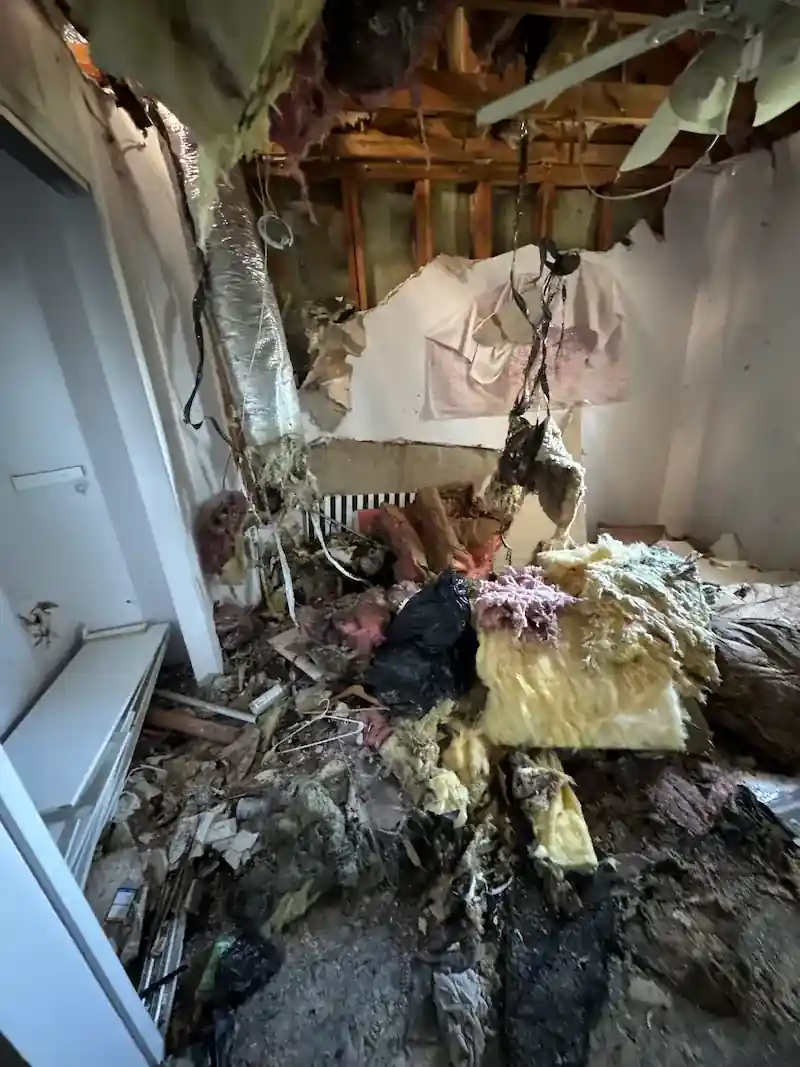
What water damage leaves in the room
Photos from one NJ job show a room after a ceiling collapse: plaster, insulation, scraps of framing and soaked furnishings all down on the floor in one heap. Nothing sits flat, nothing is dry, and sharp edges hide under the pile. That is a different problem from a flooded basement, because the debris is broken building material mixed in with a family's belongings.
Burst pipes, roof leaks and storm damage can all end the same way. A slow leak may drip for days before a ceiling gives, so the furniture underneath is soaked and the fallen material is wet and heavy. Homeowners in Morris and Essex counties call when they need a floor under their feet again and a contractor is waiting on the room.
Clearing debris without spreading it
Send photos or video of the room, or an item list, and the estimate starts there. The final price is confirmed on site once the crew sees what is wet, what is broken and how far it has spread. Same-day or next-day removal is often available, seven days a week, and emergency removals can be arranged.
On site the crew works from the doorway in. Furniture and personal items that can be saved are set aside for the family first. Then broken ceiling material and wet insulation come out in loads that will not split on the stairs. The crew does all the lifting, loading and hauling, and sweeps as it goes so debris does not trail through the hall.
Trained, in-house NJ employees do the work, with no subcontractors, and everything loads onto 25 cubic yard trucks. Donation and recycling happen whenever possible, which applies to solid furniture that sat outside the drip zone. The customer does not need to be present once access and scope are confirmed, so the owner can be at work or meeting an adjuster.
Price, limits and the cleared subfloor
Water damage cleanouts are priced as specialty cleanouts on the 25 cubic yard truck: 1/8 load $685, 1/4 $985, 1/2 $1,685, 3/4 $1,985, full truck $2,500. Specialty cleanouts price higher due to extra labor, sorting, access, or dense contents. Labor, loading, hauling, disposal fees and sweep and clean-up are included, and there is no hourly rate.
The crew removes contents and debris and nothing more. It does not repair ceilings, dry structures, test air or remediate, and a restoration contractor handles that part. The truck will not take wet paint, chemicals, fuel, gasoline, propane tanks, pesticides, asbestos, medical waste or unknown liquids. In an older house, say so at the estimate if you think a material might be asbestos.
The after photo from the collapsed-ceiling job shows the room cleared down to the subfloor. There is no heap, no wet insulation and no sharp edges waiting under a rug, only a bare room that is ready for the next trade to start. That clear floor is the whole deliverable, and it is what lets the repair schedule begin.