Why a basement fills up and stays full
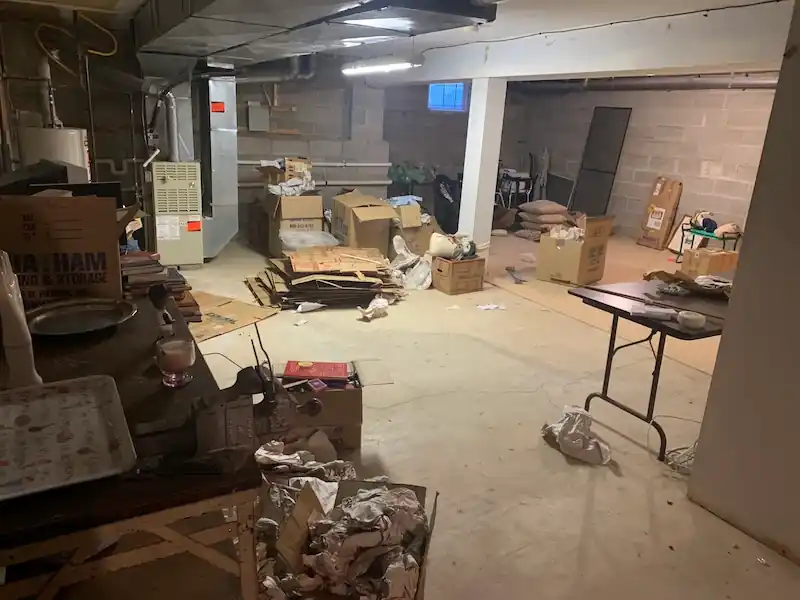
Basements collect whatever the rest of the house refuses: boxes of keepsakes, a worn-out treadmill, old tables, the washer that was too heavy to carry up. A Cranford basement in our job photos had boxes, tables and loose debris spread across the floor. That is the usual story in New Jersey houses where thirty years of storage never had a deadline.
The stairs are the real obstacle. Everything has to go up, usually around a corner, past a railing and through a door that was hung for people, not for sectional sofas. Add damp cardboard, rusted shelving and furniture too heavy to lift alone, and a basement cleanout becomes a job that people put off for years.
How the crew carries a basement out
A photo from the foot of the stairs and a rough idea of what is down there are enough for an estimate. The final price is confirmed on site. The crew then makes every trip up the stairs, loads the 25 cubic yard truck so it needs fewer runs, and sweeps the floor before leaving. You do not need to be home once access and scope are confirmed.
Our in-house New Jersey crews carry out furniture, shelving, workbenches, exercise equipment and boxes of paper. Whatever still works is donated, and the metal and electronics go to recycling. A flooded basement is a different job with its own specialty volume rate, because the contents are heavier and wetter, and it has a page of its own.
Karina Dickinson of Wharton had 30 years of storage in her basement and wrote: "What would have taken me months was done in under 4 hours." She also described the crew as upfront, quick and efficient, which is the standard we try to meet on every basement.
Basement pricing and what you get back
Basement loads are priced by the share of the truck they fill: $350 for a 1/16 load, $485 for 1/8, $685 for 1/4, $985 for 1/2, $1,685 for 3/4 and $1,985 for a full truck. Labor, loading, hauling, disposal fees and the sweep-up are included. There is no hourly rate, which matters when the stairs make the job slower than the volume suggests.
Old paint cans and propane tanks are the usual basement leftovers, and both stay behind, along with chemicals, fuel, gasoline, pesticides, asbestos, medical waste and unknown liquids. Set them aside for separate disposal before the crew arrives. Everything else on the floor and on the shelves can ride out on the truck.
A cleared Cranford basement in our photos ends as bare concrete and painted block walls, with room for laundry, a home gym or a workshop again. Same-day and next-day appointments are often possible, seven days a week, across Morris, Union, Essex and the rest of North and Central NJ.