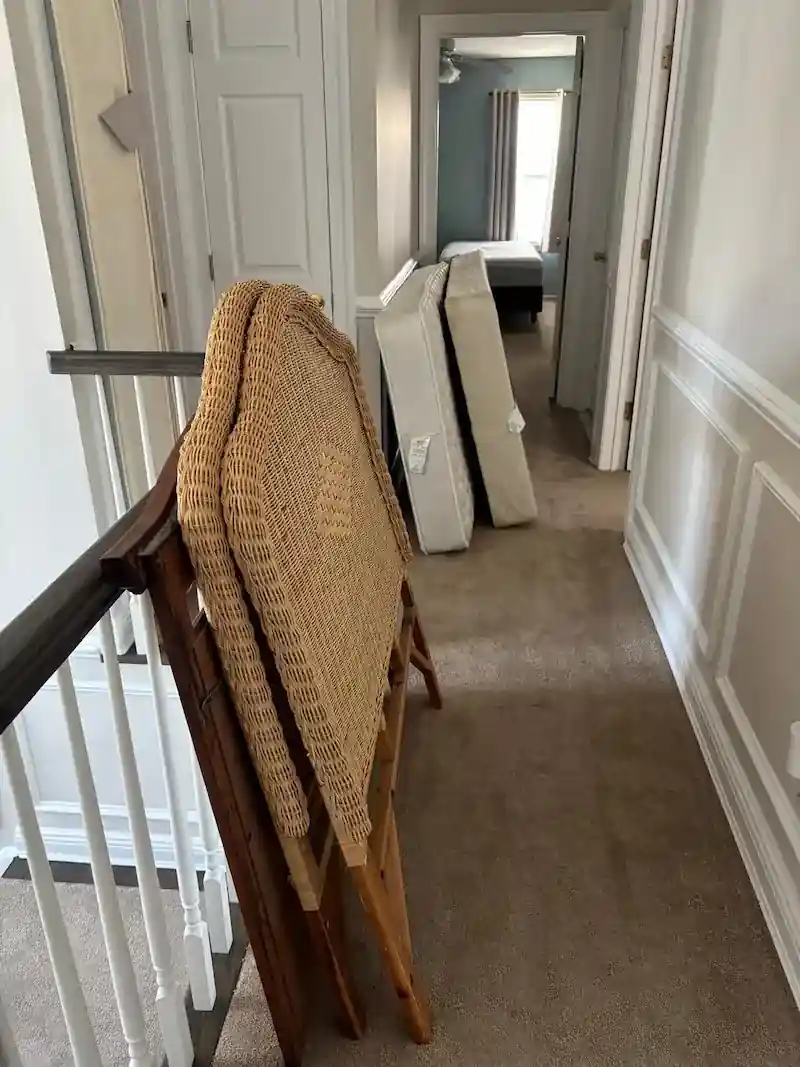
Why is a mattress such an awkward thing to throw out?
A mattress is light for its size and still impossible to carry well. It sags in the middle, it catches on every banister post, and a king won't bend through the turn at the top of a staircase. The box spring is worse, because it is a rigid frame that doesn't fold at all, so one person ends up dragging it down step by step.
Then comes the question of where it goes. A mattress and a wicker headboard leaning in a Madison hallway can sit there for months, because nobody wants to drag them outside and nobody is sure what happens next. Most people just want the bed gone from the bedroom, and the room back, by the end of the day.
How does the crew handle a mattress and box spring?
Send a photo of the bed, or list what's leaving: mattress, box spring, frame, headboard. That is enough for an estimate, and the final price is confirmed on site. The crew comes up to the bedroom, carries the pieces out flat and clear of the walls, and loads them on the truck without you lifting a thing.
Because the crew works inside the house, the mattress doesn't have to be dragged to the curb first. If you won't be home, you don't have to be, once access and scope are confirmed. A bedroom with a bed, a dresser and a nightstand can ride out on the same 25 cubic yard truck in one trip.
Price, limits and where mattresses end up
One mattress and one box spring are two items, which falls under the single item pickup price of $185 to $250. A full bedroom set is priced by volume instead, starting at $350 for a 1/16 load. Labor, loading, hauling, disposal fees and sweep-up are all included, and there is no hourly rate.
Mattresses are recycled whenever possible, and a bed in good shape that can be donated is donated. Extra-heavy or oversized pieces and difficult access can raise a single item price. The crew will not take wet paint, chemicals, fuel, gasoline, propane tanks, pesticides, asbestos, medical waste or unknown liquids left in the bedroom closet.