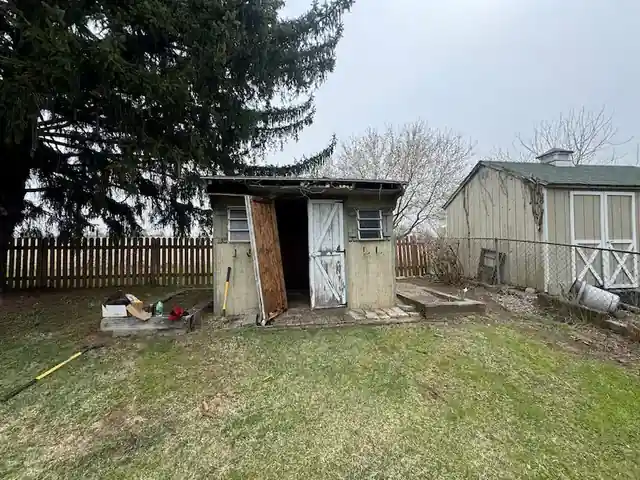
When a shed stops being storage
Most sheds don't fail dramatically. The door sags off one hinge, a corner softens, the floor goes spongy, and eventually the building is holding up nothing but its own rot. It's still too big for the curb and too solid to haul in pieces yourself. The yard keeps a footprint of it for years, a rectangle where nothing grows right.
JunkDoctors has taken down an old wooden shed in a fenced backyard, and the before and after tell the story: a standing building one day, open ground the next. Reasons vary: a shed past repair, a fence line being redone, a house going on the market. The crew works those yards across Morris, Warren and Sussex counties and the rest of North and Central NJ.
How a shed comes down
Start with photos or a short video of the shed from a couple of angles, plus a note on how the crew gets from the gate to the door. That gives you an estimate, and the crew locks in the final price at the property once they've looked at the build and the access. Slots for the same day or the next are often open, every day of the week.
The crew demolishes the shed, carries the pieces out, loads them onto the 25 cubic yard truck and sweeps up the debris they leave behind. They're trained in-house employees, never subcontractors. You don't need to be home once access and scope are confirmed, and nobody asks you to rent a dumpster first. Anything that can be donated or recycled is, whenever possible.
The $835 starting price and its limits
Shed demolition and removal starts at $835. That figure covers the full-service labor, the loading, the hauling, the disposal fees and the sweep and clean-up of the area, with no hourly rate and no hidden fees. A bigger shed, a hard-to-reach one or one packed with contents can move the number, which is why the crew confirms the price on site after seeing it.
Asbestos, medical waste and unknown liquids are off the table, and so are wet paint, chemicals, fuel, gasoline, propane tanks and pesticides. Sheds tend to hide a few of those, so walk through yours first and set aside the paint cans, the gas can and any sprayers. After the demolition the footprint is bare ground, swept clean, ready for grass seed, a new shed or a fence.