Why can't an old TV go out with the trash?
A TV looks like a simple object and is nothing of the kind. An old tube set is deep, front-heavy and awkward, and it takes two people to move one safely. A flat screen weighs less but cracks if it is carried by the edges, and a broken panel is no longer something anyone wants to handle.
Screens also carry parts that don't belong in a household bin, so a TV left at the curb in Parsippany or Randolph is a problem that comes back to its owner. Plenty of TVs sit in basements for years for exactly this reason. Nobody is sure where they are allowed to go, and nobody wants to carry them there.
How does the crew pick up a television?
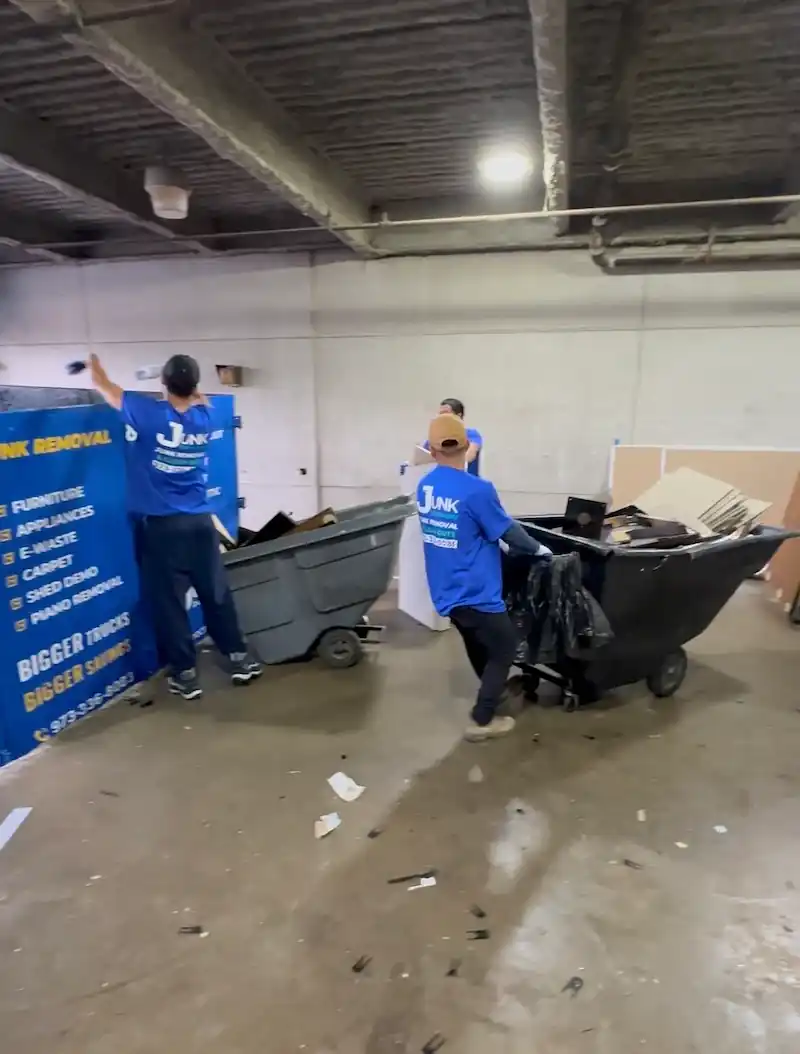
Send a photo of the TV and where it sits, or list how many there are. That is enough for an estimate, and the final price is confirmed on site. The crew lifts the set, carries it out, loads it on the truck and sweeps up, and you don't need to be home once access and scope are confirmed.
A wall-mounted screen or an entertainment center with a tube TV inside it is just another thing for the crew to unhook and carry. The TV, the stand and the old cable box can all leave together. If a cleanout is already planned for the room, the TVs ride along on the same 25 cubic yard truck.
Price, limits and where old TVs end up
One or two TVs fall under the single item pickup price of $185 to $250. Extra-heavy sets, generally over 150 lb, such as a large console TV, can raise that, as can oversized pieces or difficult access. Labor, loading, hauling, disposal fees and sweep-up are included, and there is no hourly rate.
JunkDoctors recycles and donates whenever possible, and a TV that still works and is worth donating stays out of the recycling stream. A carload of old sets in a garage is priced by truck volume rather than per set. The crew will not take wet paint, chemicals, fuel, gasoline, propane tanks, pesticides, asbestos, medical waste or unknown liquids.